4 hours ago
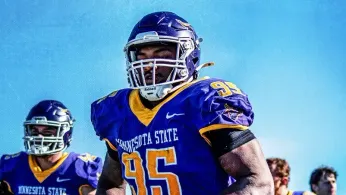
Minnesota State Football Player Marcus Hansen Shares Coming-Out Journey After Leaving Harding University
READ TIME: 3 MIN.
When defensive end Marcus Hansen arrived at Harding University, a private Christian institution in Arkansas affiliated with the Churches of Christ, he hoped to build a college football career rooted in faith and community. Instead, he found himself suppressing a core part of who he is: he is a gay man.
In a recent profile from OutSports, Hansen described how his time at Harding coincided with the intense inner conflict of being a closeted gay athlete in an environment shaped by conservative theological views on sexuality. Harding University’s student handbook outlines expectations for conduct aligned with its interpretation of Christian teachings, including restrictions on same-sex sexual behavior, policies that advocates have long criticized as creating hostile conditions for LGBTQ+ students.
Hansen eventually transferred to Minnesota State University, Mankato, an NCAA Division II public institution with a prominent football program, where he continued his career as a defensive end. Minnesota State has public non-discrimination statements covering sexual orientation and gender identity, offering a markedly different policy environment from Harding’s code of conduct.
In his interview, Hansen explained that the move to Minnesota State was not only about football but also about finding a space where he could imagine living openly as a gay man. According to him, the cultural and institutional differences between the schools shaped how safe he felt exploring his identity, underscoring how campus climate can affect LGBTQ+ athletes’ well-being.
Hansen’s story unfolds against a broader backdrop of national debate over LGBTQ+ inclusion at religious colleges and universities. Many faith-based institutions in the United States seek or maintain exemptions from certain federal non-discrimination protections, arguing for religious freedom in campus policies on sexuality and gender. Advocacy organizations and current and former students, however, have documented how such environments can contribute to isolation and mental health stress for LGBTQ+ people.
Hansen describes trying to reconcile his faith and sexuality while playing at Harding, reflecting a pattern experienced by some LGBTQ+ athletes at similar institutions. Research on queer athletes in college sports has found that athletes at schools with explicit LGBTQ+-inclusive policies report higher levels of safety, belonging, and mental health than peers without such protections.
Hansen’s decision to share his story publicly adds to a still-limited but growing number of out gay football players in U.S. college programs. Over the past decade, athletes such as Michael Sam at the University of Missouri, who came out ahead of the 2014 NFL Draft, and Scott Frantz at Kansas State University, who came out publicly in 2017, have helped increase representation of gay men in football.
Organizations like Athlete Ally and the National Collegiate Athletic Association’s Office of Inclusion have developed resources for coaches, administrators, and athletes seeking to make sports teams more welcoming to LGBTQ+ people, noting that team culture and explicit policy protections are both key factors.
By speaking about his experiences at both Harding and Minnesota State, Hansen offers a comparative glimpse into how institutional policies and campus attitudes can influence an athlete’s sense of safety. Public universities like Minnesota State that include sexual orientation and gender identity in non-discrimination statements are often cited by advocates as models for basic structural protections.
Hansen’s account emphasizes agency and self-determination: he chose to transfer, to continue playing football, and ultimately to speak publicly about being gay. Advocacy groups note that visibility from LGBTQ+ athletes can contribute to cultural change by challenging stereotypes and signaling to younger players that they can pursue both sport and authenticity.
At the same time, his journey highlights ongoing disparities between institutions in how they treat LGBTQ+ students and athletes, particularly where religious doctrine informs campus policy. For many advocates, stories like Hansen’s remain an impetus for expanding nondiscrimination protections and support systems across all levels of college sports.
Hansen continues his football career at Minnesota State while living openly as a gay man, illustrating how structural protections and inclusive culture can shape the daily realities of LGBTQ+ athletes.